For UK bus operators

The first system built around how a UK bus garage actually runs.

Run-out, allocation, defects, servicing, live telematics — the whole engineering workflow in one date-aware system that protects every scheduled mile.

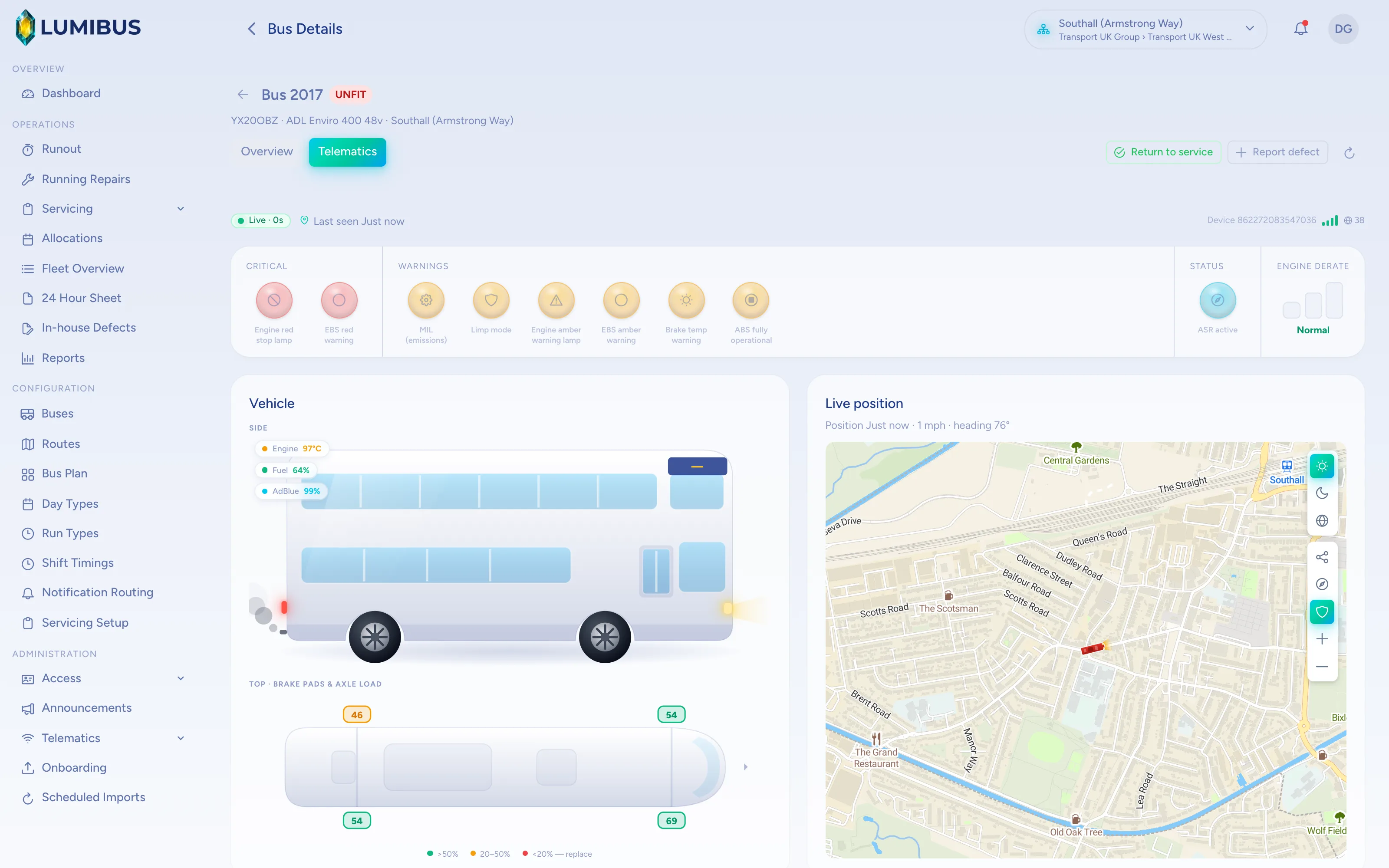
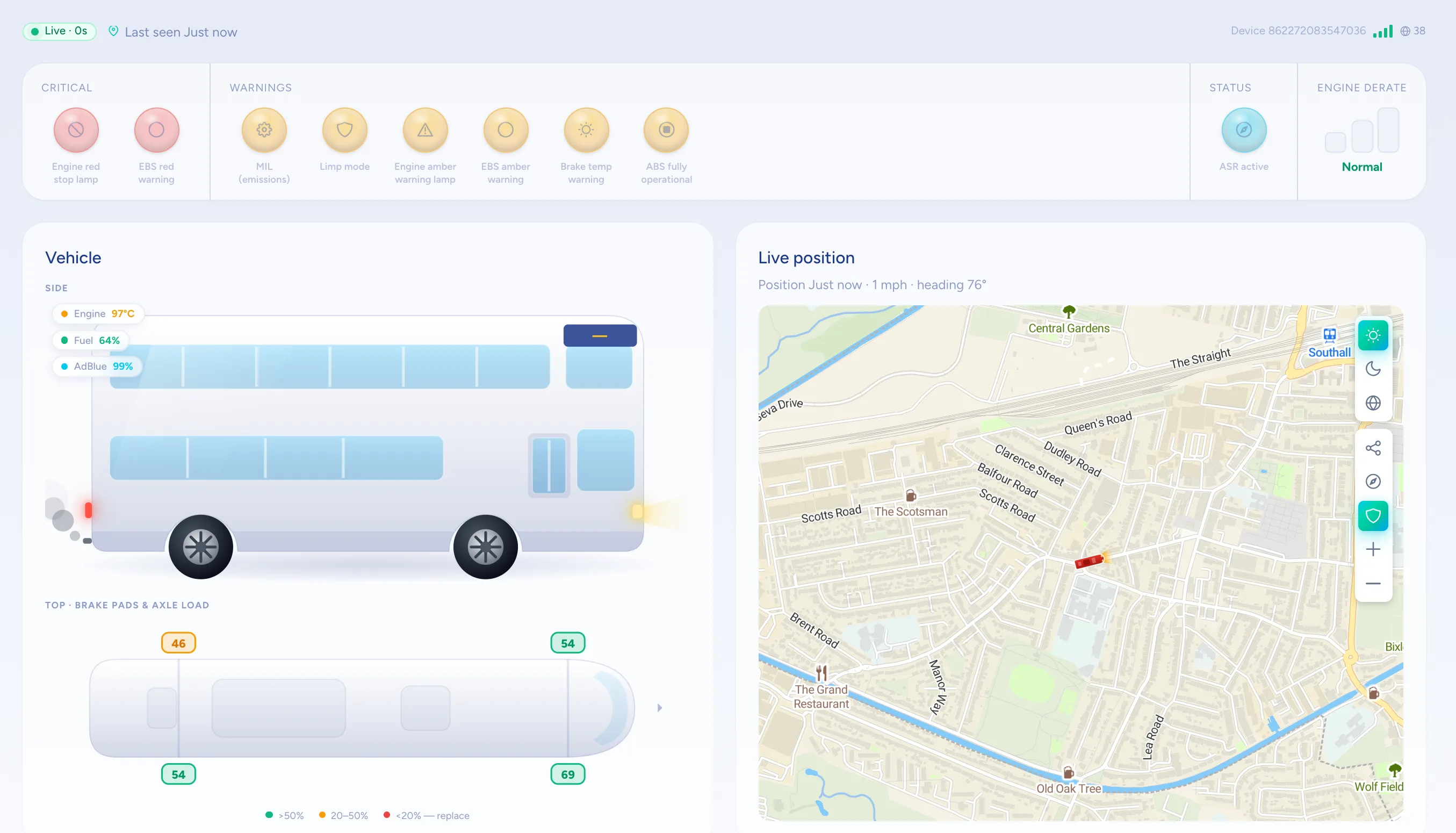
LumiBus live vehicle telematics: warning lamps, gauges, brake-pad status and live map position for a bus in service

The status quo

Your garage runs on paper and memory.

The VOR board is a whiteboard.

Nobody outside the workshop knows what's off the road, why, or for how long.

Defects live in paper books.

“Funny noise from the back” — reported at 11pm, lost by the 6am handover.

Allocation starts from scratch. Nightly.

A hundred-plus assignments rebuilt on a whiteboard or a home-made spreadsheet — when most of yesterday's board was right.

The inspection cycle is a wall planner.

One missed PMI is a prohibition notice — and a conversation with the Traffic Commissioner.

The morning starts with phone calls.

“What happened overnight?” shouldn't be a mystery you solve before 7am.

None of this is anyone's fault. There's never been a system built for how a bus garage actually works — so garages built their own, from paper, whiteboards and spreadsheets. That's the gap LumiBus was built to close.

One system, the whole cycle

A garage never stops. Neither does this.

Evening assessment

Engineering marks every bus: fit, unfit, LATE OUT, EARLY FINISH — your own run types, scoped to the date.

Allocation

The board fills itself where it can, flags what needs a human — and won't let an unfit bus on.

Pull-out

The run-out is the morning's single source of truth: every running number, every bus, every status.

In service

A failure becomes a recorded substitution, not a radio scramble.

Overnight workshop

Defects flow to the night crew with photos and history. Nothing is lost at changeover.

The inspection cycle

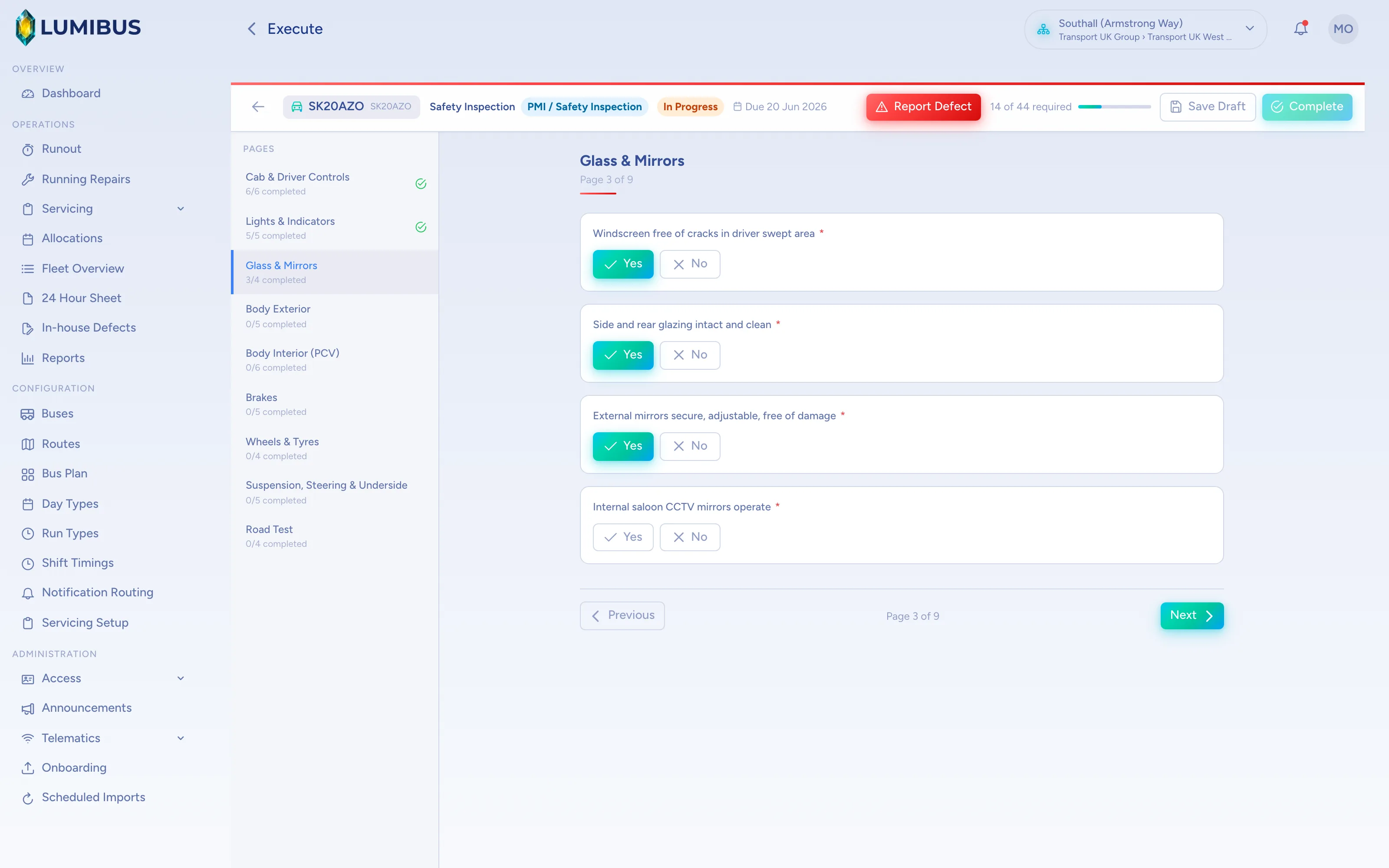
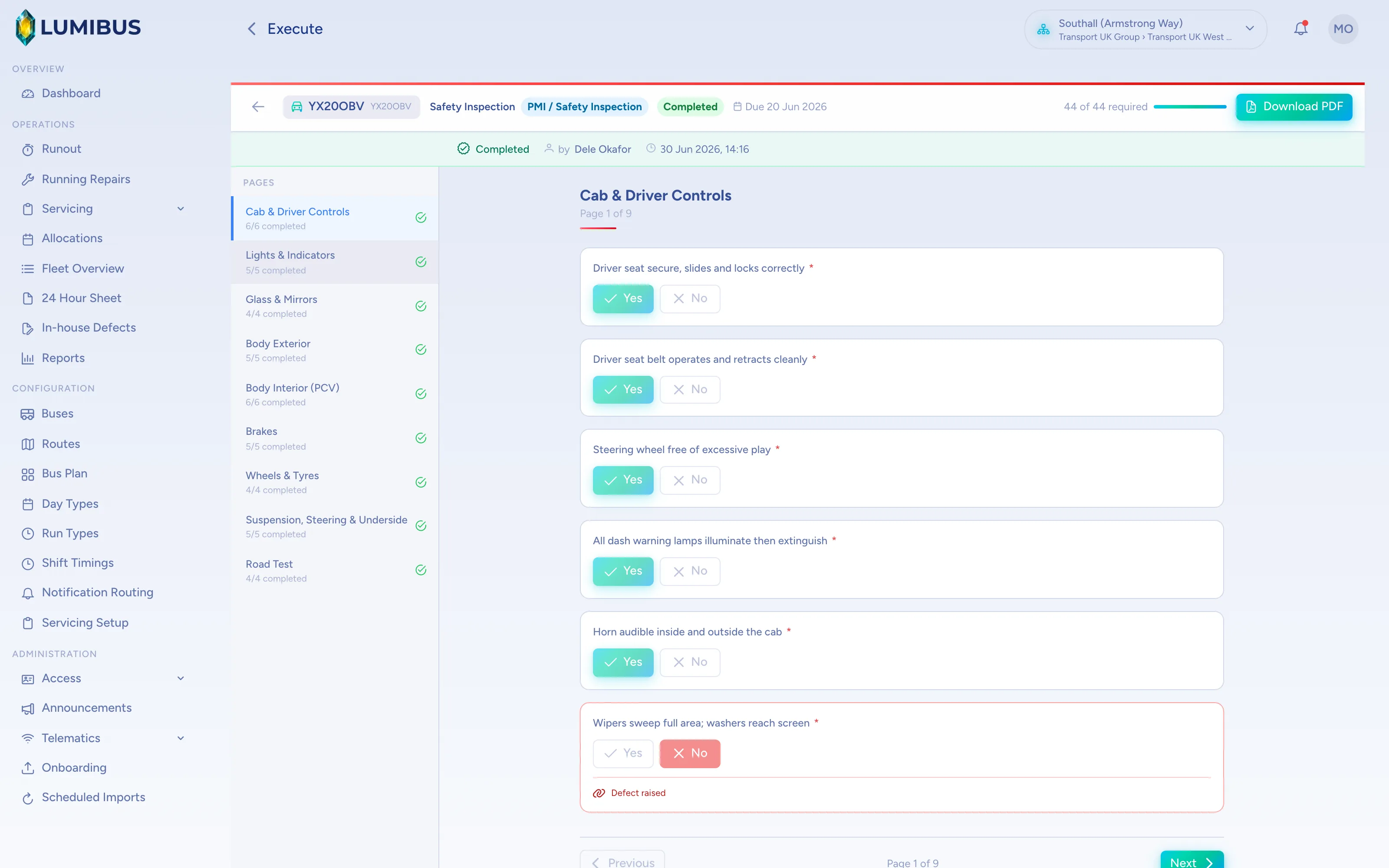
Rotating DVSA cycles chase themselves — records render as documents you'd hand an examiner.

Every switchover, changeover and cadence is configuration. LumiBus runs on your garage's clock — not ours.

The system

One system. The whole workflow.

01 — Run-out

The day's single source of truth.

Everything on the road, date-scoped: every running number, the bus covering it, and its status. When a bus fails mid-service, the swap is a recorded substitution — reason, available-bus picker, reminders, full history. Multiple substitutions on the same run-out? Handled.

Every mile accounted for. Every swap on the record.
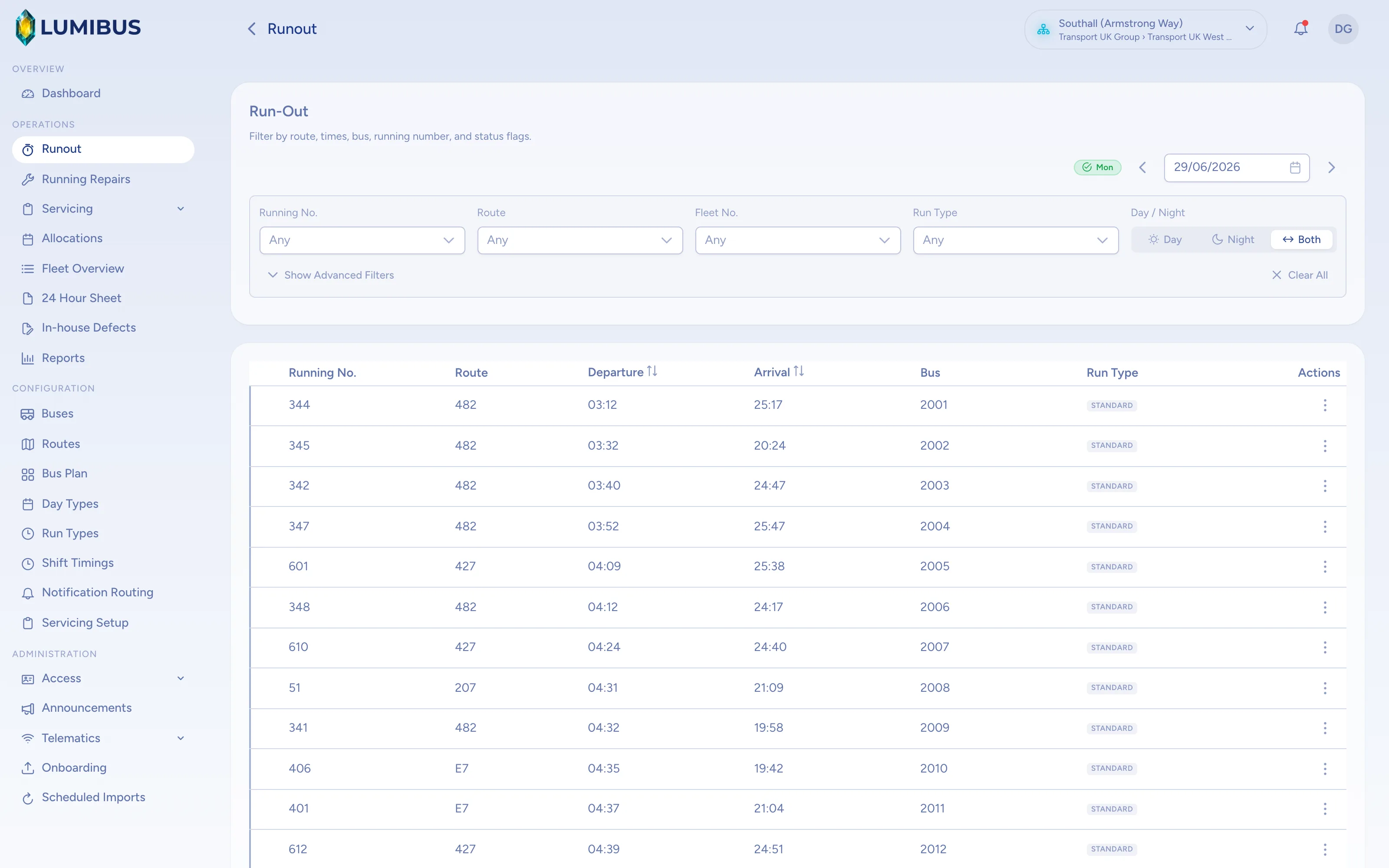
LumiBus run-out board: the day's running numbers, routes, departure times and allocated buses

02 — Allocation

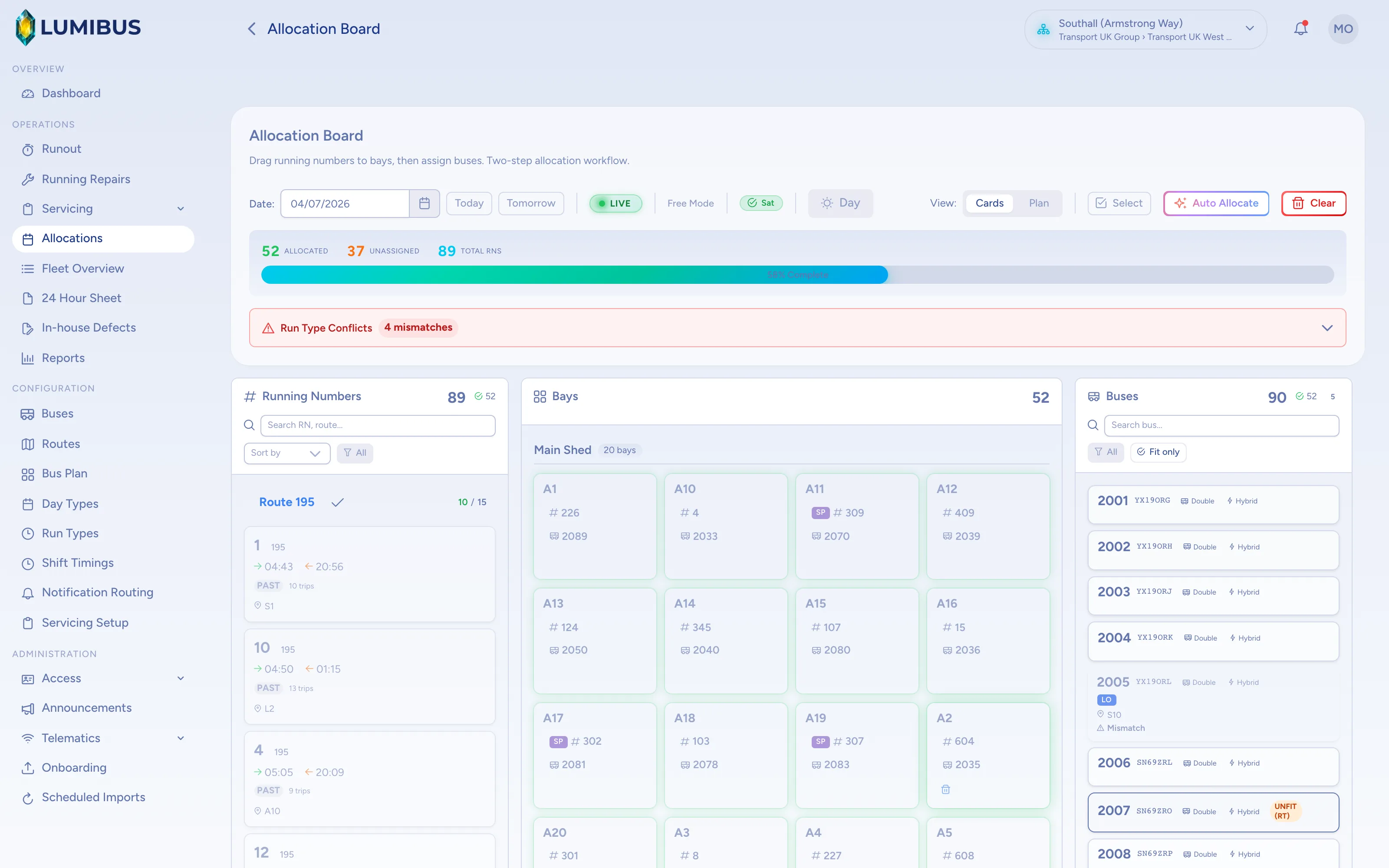
The board that listens to engineering.

Running numbers are auto-categorised from the schedule itself — spreadovers detected, late departures, early finishers. A bus engineering marked LATE OUT matches naturally to a LATE OUT running number, and a mismatch is flagged before the bus is on the board — not at 5am on the yard. The AI auto-allocator plans on your depot's own drawn bay plan, understands exit paths and physical blocking, and an unfit bus simply cannot be dragged into service.

Hours back, every single night.

LumiBus allocation board: running numbers, bays and buses in a drag-and-drop three-column workflow

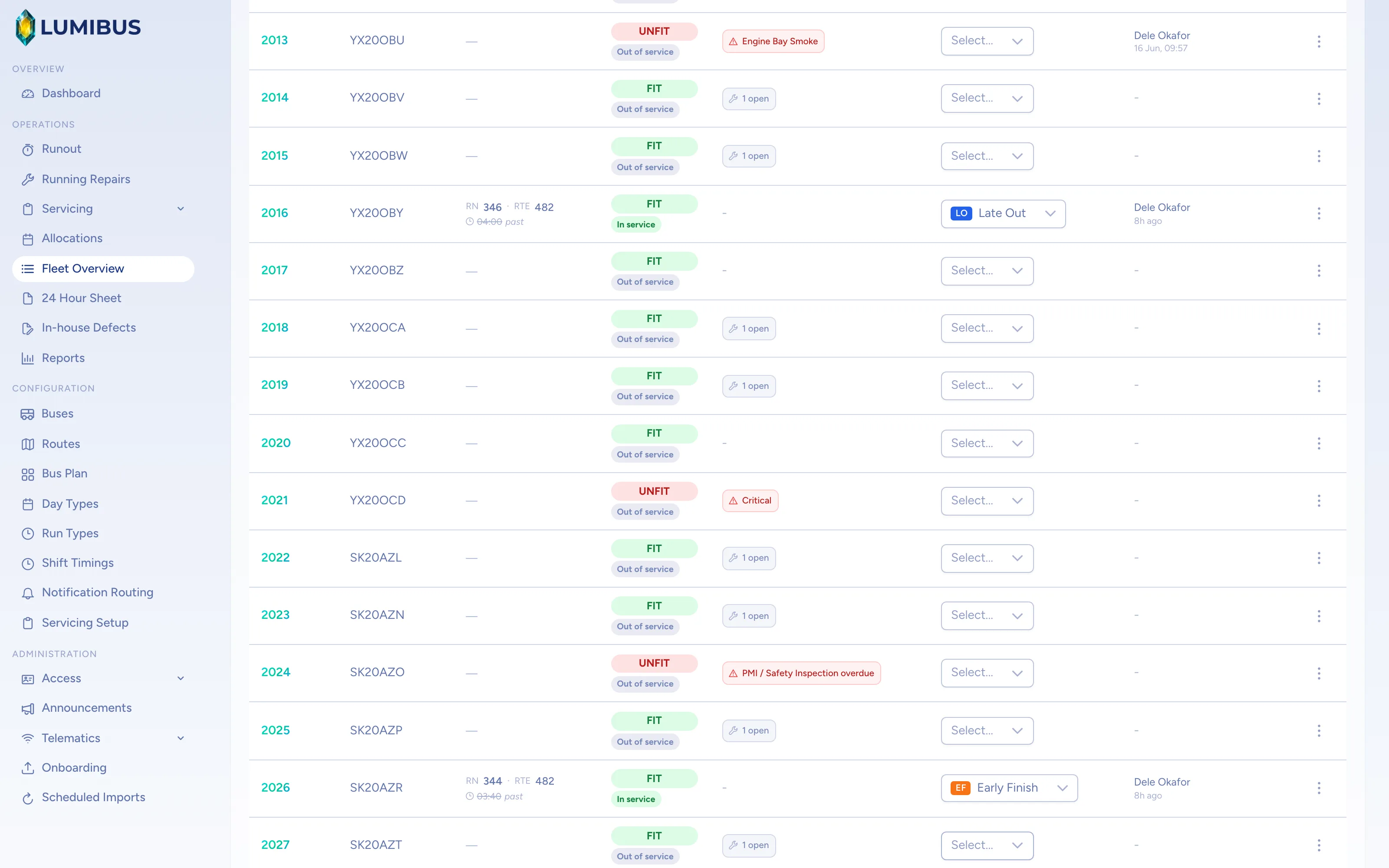
03 — Fleet overview

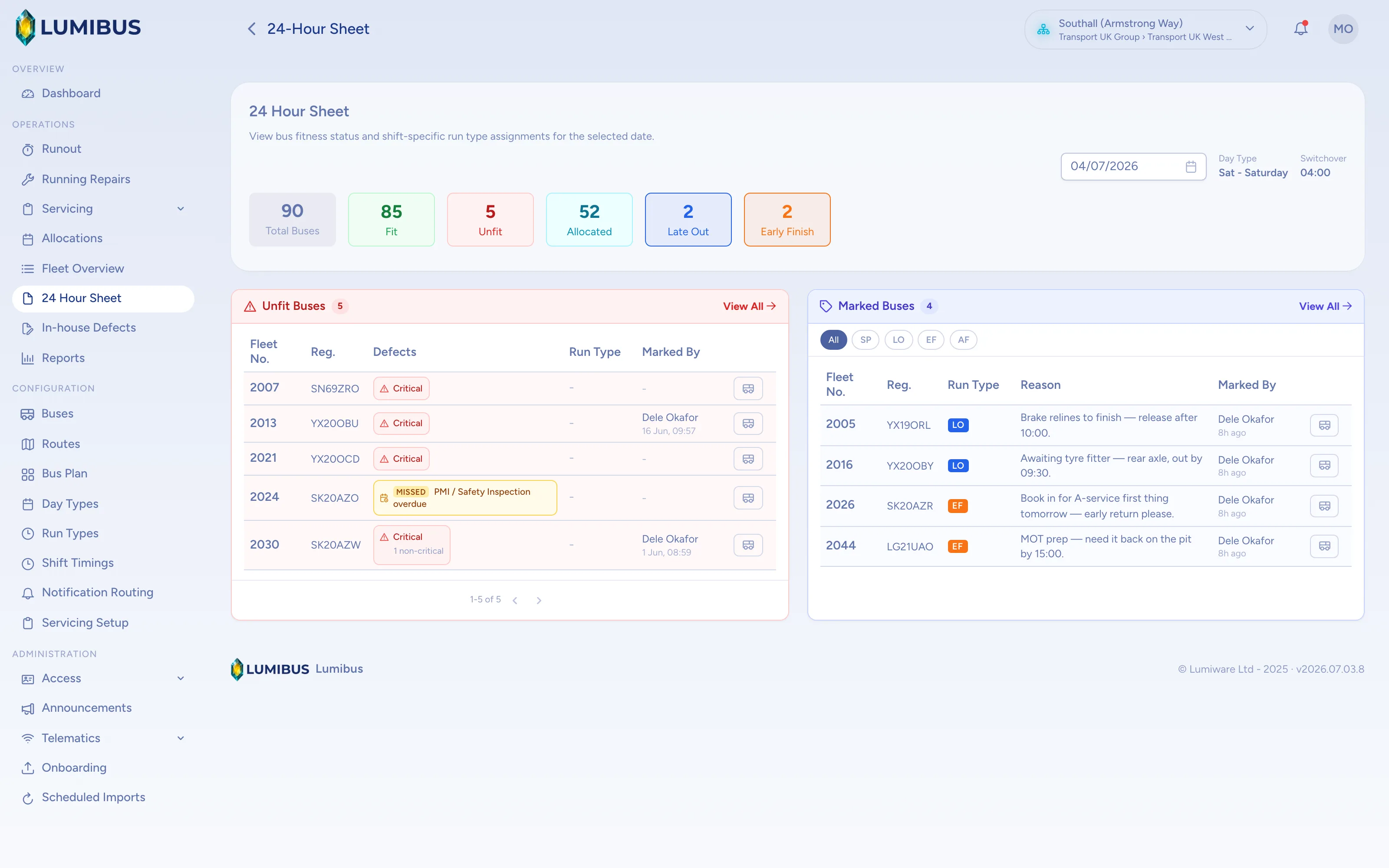
The 24-hour sheet, digitised.

The evening engineering assessment, off the clipboard: fit or unfit with reasons, and date-scoped markings — LATE OUT, EARLY FINISH, or run types you define — that apply to a date and expire on their own. No stale scribbles. This is where the markings the allocation board listens for come from.

The whole depot working from one truth.

LumiBus fleet overview: per-bus fitness status, defects and run-type markings like Spreadover, Late Out and Early Finish

04 — Defects & the workshop

Nothing falls through the handover.

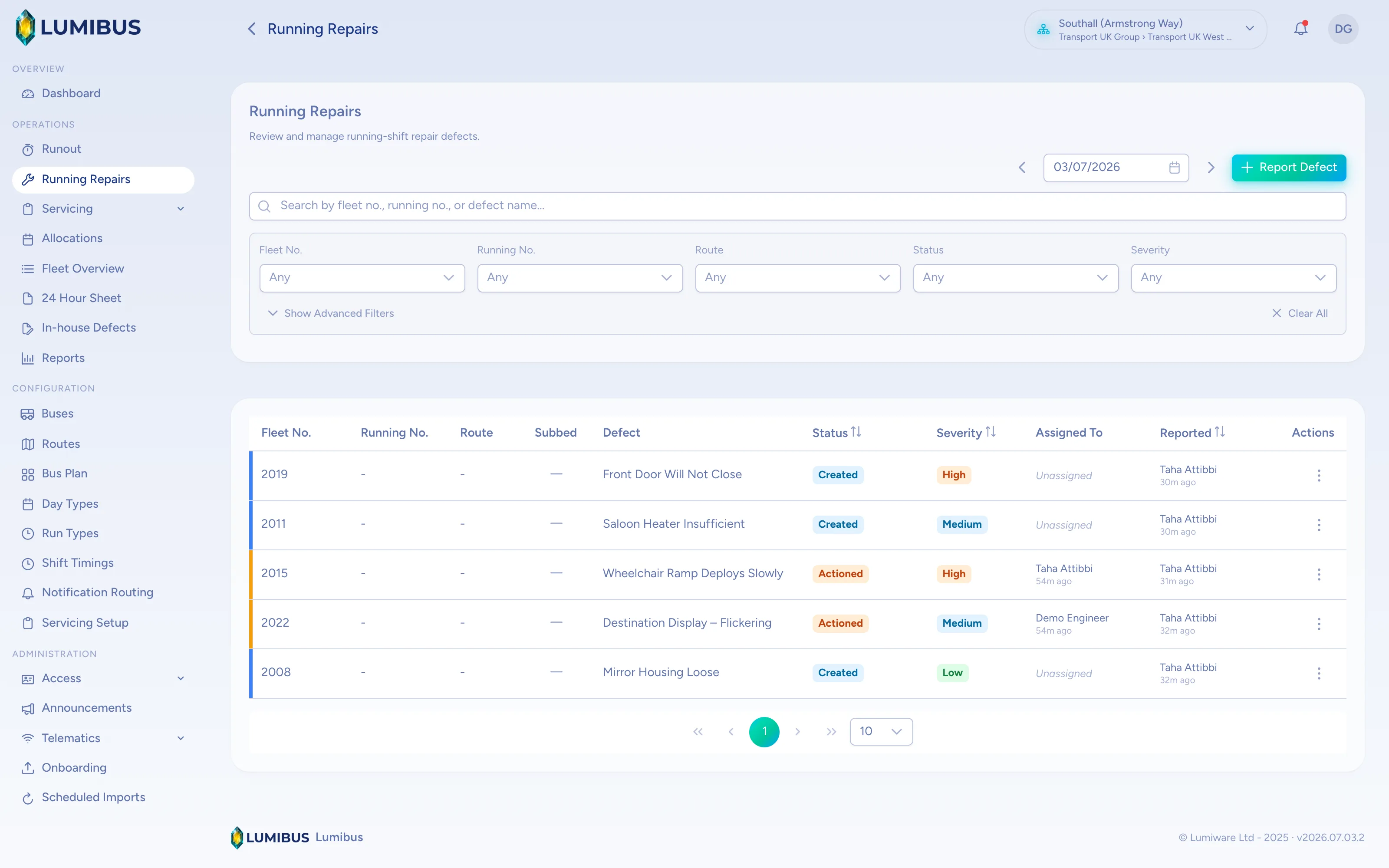
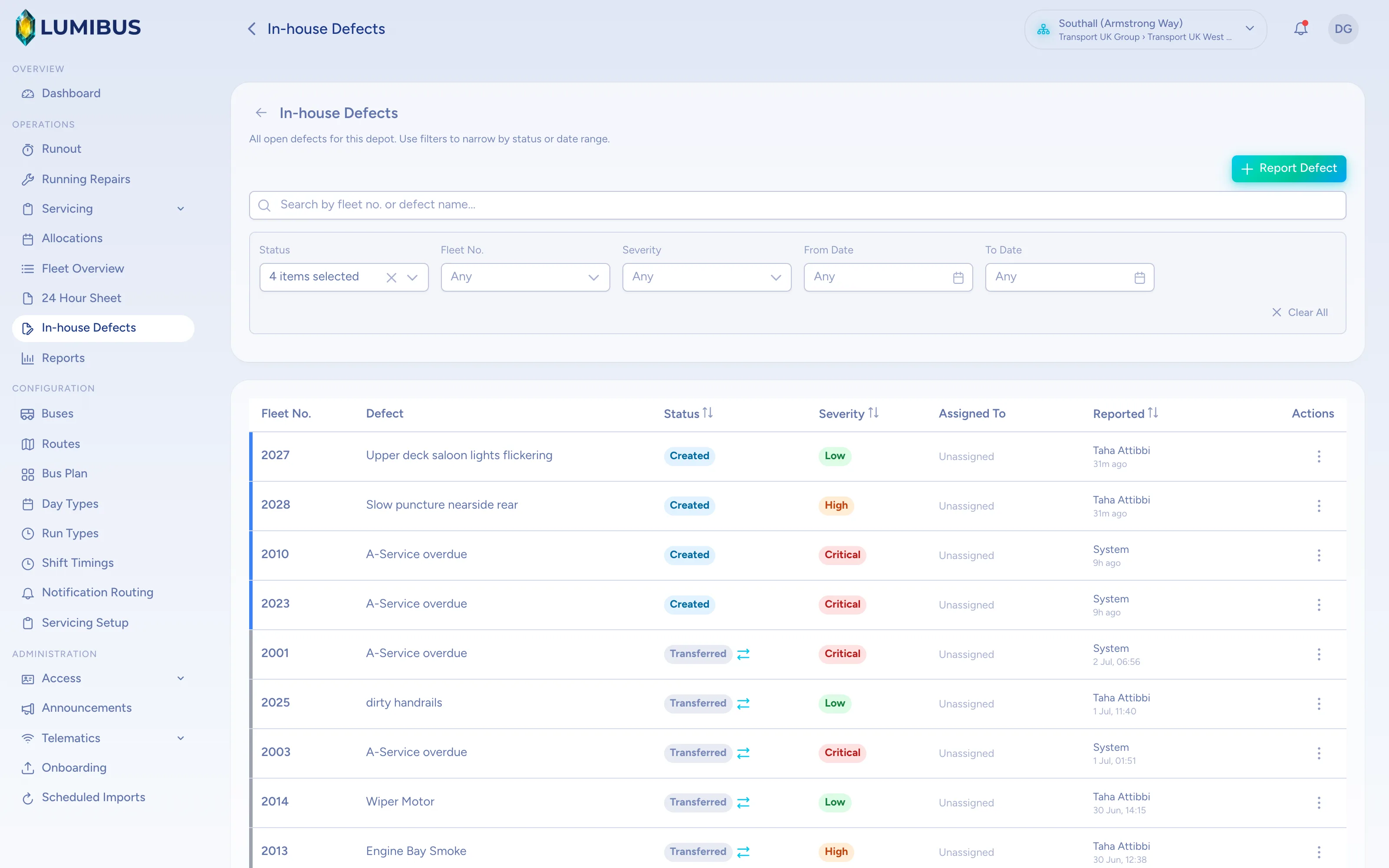
From a driver's running repair to an in-house workshop job: photos, severity, full history and recurrence linking, so the fitter sees what this bus has done before. Open running repairs transfer automatically at every shift changeover you configure. And a safety-critical defect marks the bus unfit on its own — no memo required.

22:41 Driver reports: “brakes feel soft”

22:41 Safety-critical → bus marked unfit, off tomorrow's board

23:05 Night crew picks it up — full history attached

04:50 Repaired, signed off, fit — back on the board

No lost repairs. Fewer morning failures.

LumiBus running repairs queue: reported defects with severity, status and assignment
LumiBus in-house workshop defect list

05 — Servicing & DVSA

Compliance that chases itself.

Rotating inspection cycles — A/B/C/D services, two-year, MLR, PDI — scheduled per bus, with overdue chasing and a forward workload forecast. Records render as white-label PDF documents with your logo and legal identity: paperwork you'd hand to an examiner. Behind it, a full audit trail — who marked the bus fit, who signed off the repair, when the inspection happened.

No prohibition ever caused by a missed date.

LumiBus servicing forecast: workshop load heatmap and compliance breach-risk indicators

06 — Telematics & geofencing

Data that ends in a workshop action, not a report.

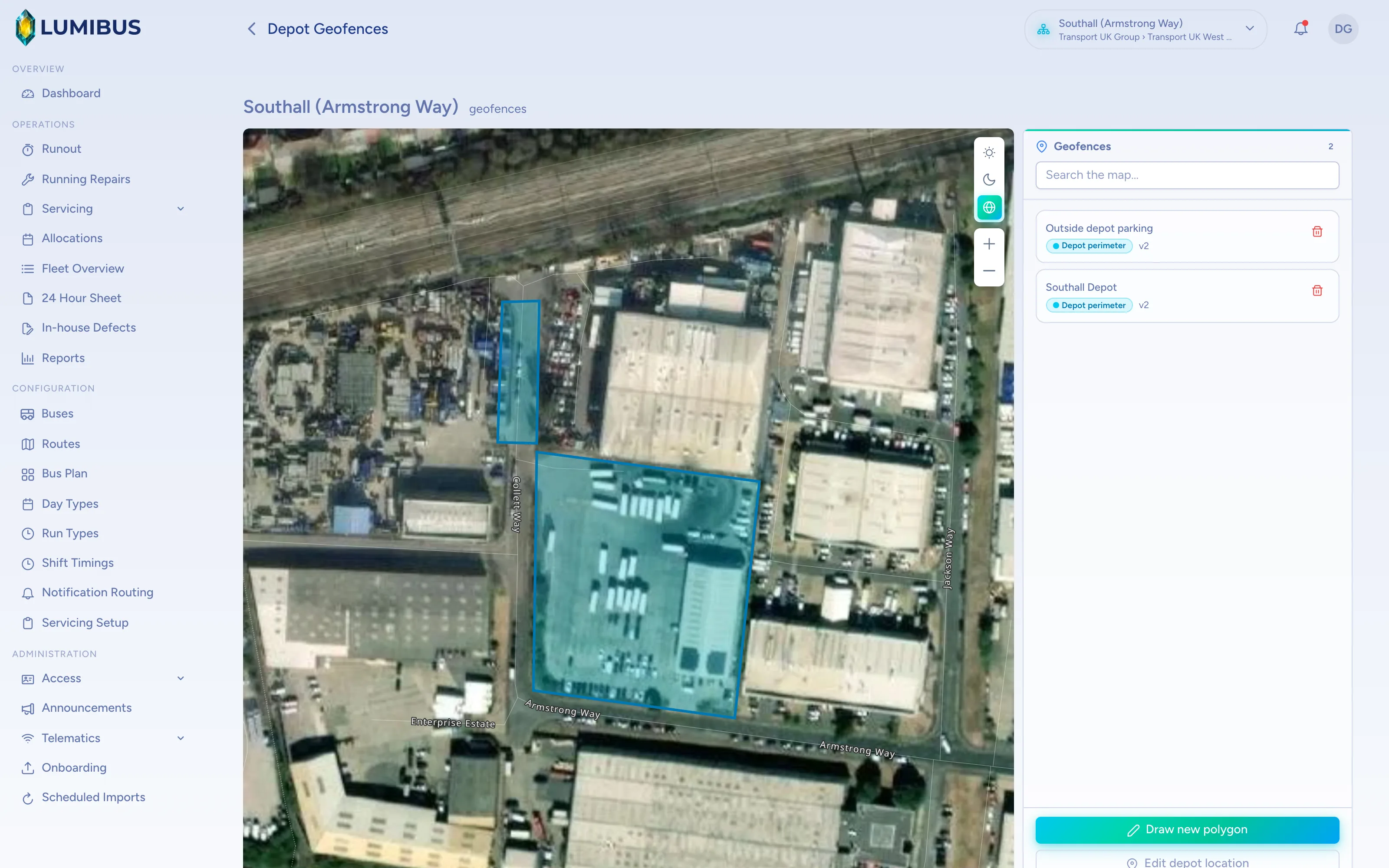
Live speed, air pressure, temperatures and fault codes, updating every couple of seconds while the bus is driving. Draw your depot boundary on the map and know the moment a bus enters or leaves — before anyone radios it in. Alert rules feed the same fitness and defect workflow your workshop already runs. This isn't another map portal engineering never opens.

Problems caught while the bus is still earning mileage.

LumiBus depot geofences drawn over satellite imagery of the depot yard
LumiBus live telematics cockpit for a bus in service

The copilot

Say it. It's done.

“Mark 47121 fit — repairs complete, pads replaced.”

“Which buses are still off the road, ranked by priority?”

“What changed between six last night and six this morning?”

Voice input for the pit. A morning briefing for the manager. Dozens of questions it can answer and actions it can take — against the same system of record, with every change audited.

Why it pays

Mileage and efficiency aren't features.
They're the requirement.

Every un-repaired bus is lost mileage against the contract. Missed performance moves real contract money. Night-shift hours are the most expensive in the garage. LumiBus was built with that arithmetic as a design requirement, not an afterthought — VOR visibility, allocation carry-over, changeover transfer and overdue chasing all exist because of it.

80%

of daily allocations repeat day to day — yet most garages rebuild the board from scratch every night

15%

of daily allocation is reactive rework — sickness, breakdowns, late changes

every

day off the road is deducted mileage on a TfL contract — VOR isn't a whiteboard problem, it's a money problem

Industry statistics — UK bus operations research, not LumiBus results.

Getting live

Live in about an hour. Not a data-entry project.

London depots

Schedule import direct from iBus — running numbers and blocks arrive exactly as your garage already knows them. One-click TfL import covers every London route.

Everywhere else

Import straight from your published BODS timetable — any UK operator, no re-keying.

  1. 0:00 Import your schedule — iBus, TfL or BODS
  2. 0:10 Bulk-load the fleet from CSV
  3. 0:20 Draw your bay plan
  4. ~1:00 Tonight's board, in LumiBus

And when the schedule changes, it re-imports itself — weekly, automatically.

See your garage in it.

Thirty minutes. Your depot, your routes, your running numbers.

Your rostering system keeps the drivers — LumiBus takes the buses off the whiteboard. No rip-and-replace: schedules import straight from iBus, BODS or GTFS.